Introduction card
Expanding your vocabulary: five themes from the bac pro programme
| Students | Seconde, Première and Terminale bac pro. Level B1, with support (help lines, word boxes, examples). The programme expects B1+ in language A at the end of the bac pro. |
|---|---|
| Length | Five sessions of 55 minutes. Each one can be taught alone, but the recaps link them: each session opens with a marked recap of the one before. |
| Objectives | Learn words by theme, in families and in fixed pairs (collocations), with phrasal verbs. Read a topical text and choose the right word. Reuse the words in a short speaking or writing task. One grammar point per session, tied to the words. |
| Each session | A marked recap, a word box, a cloze text with four options, word families and phrasal verbs, a grammar point, a speaking or writing task, the homework, and extra tasks in the homework bank. All answers are hidden until you open them. |
| Link with the exam and with work | In the written part of the bac pro, you understand an audio or video document and a short text, then write 100 to 120 words on one of two subjects, one about daily life and one about work. In the oral part, you speak for up to five minutes about a project or a work experience, which can be a placement abroad, then talk with the examiner for up to five minutes. Sessions 4 and 5 prepare these two oral topics. Precise words make you clearer with an examiner, a client or a tutor. |
| Before these sessions | Public Transport in London, Licence to Learn and Ce qui nous lie. |
| Materials | This page on a phone or a computer, or printed without the answers. A vocabulary notebook. |
| Other version | dys-friendly version. |
Teacher note: which theme of the official programme each session matches
Programme of modern languages for CAP and baccalauréat professionnel classes, decree of 3 April 2019, official bulletin, special issue no. 5 of 11 April 2019. The programme has no axes: it lists study themes for cultural knowledge and vocabulary, in two contexts, daily, personal, social and citizen life, and professional life. The themes below are translated from the official text.
| Session | Theme in the programme |
|---|---|
| Session 1 · Wild weather, greener habits | Major current issues and their impact in English-speaking countries: environment, sustainable development and ecological transition. Daily, personal, social and citizen life. |
| Session 2 · Check before you share | Media (press, radio, television), social networks and the internet: practices and issues. Task named in the programme: understand, analyse and report on press articles and information campaigns. |
| Session 3 · Shopping online, sorting out a problem | Consumer habits, major national retailers, online shopping. Tasks named in the programme: ask for information as a customer about a purchase, an order or delivery times; make a complaint, orally or in writing. |
| Session 4 · Giving time, making a difference | Forms of humanitarian and citizen engagement in English-speaking countries (NGOs, volunteering, charities). Task named in the programme: build an argument to get your classmates to join a project. |
| Session 5 · Going abroad for a work placement | European mobility programmes and mobility in general, expatriation. Also: application procedures and job interview codes, and the social codes for welcoming people. Professional life. |
The format, a topical text with gaps and four options followed by other word tasks, is a classic of vocabulary practice. All texts, examples and exercises on this page were written for these sessions.
The painting of this sequence
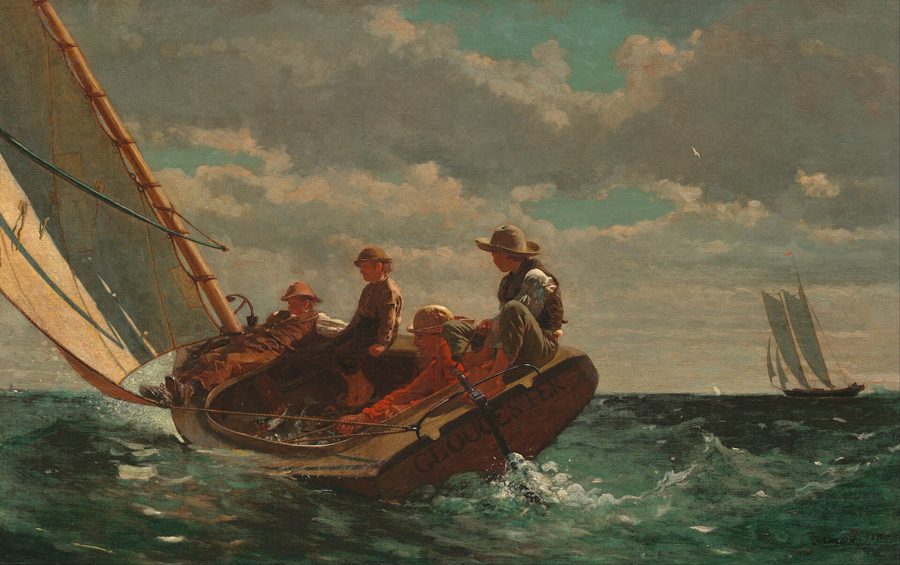
Warm-up, 3 minutes. Look at the painting. Name five things you can see, then three words for the weather and two words for how the boys might feel.
Possible answers
Things: a sailing boat, a sail, the sea, waves, clouds, a hat, a rope, a ship in the distance. Weather: windy, cloudy, a fresh breeze, choppy sea. Feelings: excited, confident, a little scared, focused. The title says it all: “breezing up” means the wind is getting stronger, and a “fair wind” helps the boat move forward. The painter signed and dated it 1876.
Session 1 · 55 minutes
Wild weather, greener habits
Official programme. Major current issues and their impact in English-speaking countries: environment, sustainable development and ecological transition. Daily, personal, social and citizen life.
By the end of the session, I can talk about extreme weather, explain what a town and a person can do, give advice with if.
Lesson plan (55 minutes)
- Marked recap while the register is taken: 5 min
- Word box, read aloud and explained: 7 min
- Exercise 1, cloze text: 10 min
- Exercise 2, word families and phrasal verbs: 10 min
- Exercise 3, grammar: 8 min
- Exercise 4, speaking or writing: 12 min
- Homework written in planners: 3 min
Marked recap · 5 minutes · out of 5
Session 1 · What you already know
While the register is taken, one student presents this recap, prepared at home. It draws on what you learnt in collège and in Seconde, and on Public Transport in London. The class listens, then adds details if needed.
| Question | Marks |
|---|---|
| Give four weather words: one for the sun, one for rain, one for wind, one for cold. | 1 mark |
| Past simple: go, see, make, take. | 1 mark |
| In Public Transport in London, you met the red buses and the Tube. Why is the bus greener than the car? One sentence. | 1 mark |
| Name two ways to save energy at home. | 1 mark |
| Voice, eye contact, no reading from notes. | 1 mark |
Recap answer key
- Give four weather words: one for the sun, one for rain, one for wind, one for cold.
sunny, rainy, windy, cold or icy (also: cloudy, stormy, foggy, snowy). - Past simple: go, see, make, take.
went, saw, made, took. - In Public Transport in London, you met the red buses and the Tube. Why is the bus greener than the car? One sentence.
Example: “One bus carries many people, so it produces less pollution per person than a car.” - Name two ways to save energy at home.
Examples: turn off the lights, take shorter showers, unplug chargers, turn the heating down. - Voice, eye contact, no reading from notes.
Voice heard at the back of the room, eyes on the class.
Word box
| Word | Meaning | Example |
|---|---|---|
| a heatwave | a period of very hot weather | The heatwave lasted ten days and schools closed early. |
| a drought | a long time without rain | After the drought, the river was almost dry. |
| a flood | water that covers land which is usually dry | The flood damaged forty houses near the river. |
| heavy rain | a lot of rain in a short time | Heavy rain is expected tonight. |
| to warn | to tell people that something bad may happen | The town warned people not to drive. |
| to adapt (to) | to change in order to deal with a new situation | Farmers adapt to drier summers. |
| waste | things we throw away; also a verb: to use badly | Our canteen produces too much food waste. |
| renewable energy | energy from the sun, the wind or water | Solar panels produce renewable energy. |
| a carbon footprint | the amount of greenhouse gas you produce | Flying increases your carbon footprint. |
| to make a difference | to have a good effect | Small actions can make a difference. |
Exercise 1Cloze text · When the weather goes wild
Instructions. Read the text. For each gap, choose a, b, c or d. Then press “Check my answers”.
Heatwaves, floods and storms are in the news more and more often. Scientists explain that a warmer planet (1) more extreme weather. In summer, a long (2) can dry up rivers and destroy crops. In winter, (3) rain can make rivers burst their banks and cover whole streets with water.
Towns are learning to (4) to these changes. Some plant trees to give shade in the streets, others build walls to (5) homes near the sea. When a dangerous storm is coming, the authorities (6) people with an alert on their phones and tell them to stay indoors.
We can all help, too. We can (7) down on waste, take the bus instead of the car, and turn off the lights we do not need. Small actions will not stop climate change on their own, but together they (8) a real difference.
A text written for this session. The facts are general and widely documented.
- a) leads · b) brings · c) makes · d) gives
- a) drought · b) flood · c) wave · d) shower
- a) strong · b) heavy · c) big · d) thick
- a) adopt · b) adapt · c) accept · d) admit
- a) protect · b) prevent · c) avoid · d) keep
- a) warn · b) advise · c) notice · d) alarm
- a) cut · b) put · c) break · d) slow
- a) do · b) give · c) make · d) take
Answer key
- b) brings. bring + noun. lead needs to: “leads to more extreme weather”.
- a) drought. A long time without rain is a drought.
- b) heavy. Collocation: heavy rain (but a strong wind).
- b) adapt. adapt to a change. adopt means to take as your own.
- a) protect. protect homes (from the sea).
- a) warn. warn someone of a danger.
- a) cut. Phrasal verb: cut down on = reduce.
- c) make. Collocation: make a difference.
Exercise 2Word families, collocations and phrasal verbs
Learn words in families and in pairs: a verb is easier to use when you know the noun it goes with.
| Verb | Noun | Adjective |
|---|---|---|
| to pollute | pollution, a polluter | polluted |
| to protect | protection | protective |
| to waste | waste | wasteful |
| to sustain | sustainability | sustainable |
| to destroy | destruction | destructive |
Collocations: raise awareness, take action, save energy, reduce waste, a strong wind, heavy rain. Phrasal verbs: cut down on (reduce), throw away (put in the bin), run out of (have none left), turn off (stop a machine), pick up (take from the ground), set up (start, organise).
Instructions. Complete with the missing word: a particle (off, up, away, out, down) or a word from the table. Then press “Check my answers”.
1. Please turn the lights when you leave the workshop.
2. If we keep wasting water, we will run of it.
3. Don’t throw your old phone: recycle it.
4. Let’s set a recycling corner in the canteen.
5. Plastic bags cause a lot of in the oceans.
6. Leaving the heating on all night is very .
Answer key
1. off. 2. out. 3. away. 4. up. 5. pollution (noun after a lot of). 6. wasteful (adjective after very).
Exercise 3Grammar tied to the words: the first conditional
To talk about a real possibility and its result: If + present simple, will + base verb.
If we plant more trees, the streets will be cooler.
If you take the bus, you will reduce your carbon footprint.
Trap. No will after if: not “If it will rain”, but “If it rains, we will stay inside.”
Instructions. Put the verbs in the correct form.
- If it (rain) ___ tonight, the river (flood) ___ the road.
- If we (turn off) ___ the computers, we (save) ___ energy.
- You (feel) ___ better if you (drink) ___ water during the heatwave.
- If the town (not / build) ___ a wall, the sea (destroy) ___ the houses.
Answer key
- If it rains tonight, the river will flood the road.
- If we turn off the computers, we will save energy.
- You will feel better if you drink water during the heatwave.
- If the town does not build a wall, the sea will destroy the houses.
Exercise 4Speak or write: one green tip for our school
Speaking (1 minute) or writing (60 to 80 words). You record a short tip for the school website. Say what the problem is, give one action, and say what will happen if everyone does it. Use three words from the box, one phrasal verb and one sentence with if.
Model answer
Model. “Every day, our canteen throws away a lot of food. This waste is bad for the planet and for our budget. My tip: take only what you will eat, and come back for more if you are still hungry. If everyone does this, we will cut down on food waste and the canteen will save money. It is a small action, but it can make a real difference.” (73 words)
Session 1 · to do before the next lesson
Homework
Write it in your planner now. More tasks for this session are in the homework bank at the end of the page.
- Learn and use. Copy five words from the box into your vocabulary notebook. For each one, write a sentence about your town, your home or your workshop.
- Word families. Complete with a word from the same family. a. The factory was fined for (pollute) ___ the river. b. We need more (protect) ___ against floods. c. Wind power is a (sustain) ___ source of energy. d. The storm was very (destroy) ___ .
- If sentences. Write three sentences with if about your trade or your daily life. One must be negative.
Homework answer key
- Learn and use. Personal answers. Example: “Last summer, during the heatwave, we worked in the workshop from 7 to 12 to avoid the hottest hours.” Check: one word per sentence, correct spelling, a real situation.
- Word families. a. polluting (after a preposition: -ing). b. protection. c. sustainable. d. destructive.
- If sentences. Personal answers. Models: “If I switch off the machine at night, the workshop will use less energy.” “If we don’t sort the waste, the bins will overflow.” “If I cycle to school, I will save money.”
Session 2 · 55 minutes
Check before you share
Official programme. Media (press, radio, television), social networks and the internet: practices and issues. Task named in the programme: understand, analyse and report on press articles and information campaigns.
By the end of the session, I can talk about news and social networks, say if a source is reliable, ask and answer about experiences with the present perfect.
Lesson plan (55 minutes)
- Marked recap while the register is taken: 5 min
- Word box, read aloud and explained: 7 min
- Exercise 1, cloze text: 10 min
- Exercise 2, word families and phrasal verbs: 10 min
- Exercise 3, grammar: 8 min
- Exercise 4, speaking or writing: 12 min
- Homework written in planners: 3 min
Marked recap · 5 minutes · out of 5
Session 2 · What you already know
One student presents this recap, prepared at home. It draws on session 1.
| Question | Marks |
|---|---|
| Complete the collocations: ___ rain, a ___ wind. | 1 mark |
| What does cut down on mean? Give an example. | 1 mark |
| Finish the sentence: “If we waste water, ...” | 1 mark |
| Give the noun and the adjective of to pollute. | 1 mark |
| Voice, eye contact, no reading from notes. | 1 mark |
Recap answer key
- Complete the collocations: ___ rain, a ___ wind.
heavy rain, a strong wind. - What does cut down on mean? Give an example.
To reduce. “I am cutting down on plastic bottles.” - Finish the sentence: “If we waste water, ...”
“... we will run out of it.” (will + base verb) - Give the noun and the adjective of to pollute.
pollution (also a polluter), polluted. - Voice, eye contact, no reading from notes.
Voice heard at the back of the room, eyes on the class.
Word box
| Word | Meaning | Example |
|---|---|---|
| a headline | the title of a news article | The headline said the school would close, but it was a joke. |
| a source | where information comes from | Always check the source of a photo. |
| reliable | that you can trust | The BBC website is a reliable source for news. |
| fake | not real, invented to trick people | The video was fake: it was made with AI. |
| to share | to send a post to other people | She shared the post with her friends. |
| a follower | a person who sees your posts | The account has two million followers. |
| to scroll | to move down a screen with your finger | I scroll for hours before I sleep. |
| to check | to make sure something is true | Check the date before you share. |
| a fact checker | a journalist who verifies information | Fact checkers proved the photo was old. |
| screen time | the time you spend in front of a screen | My phone shows my screen time every week. |
Exercise 1Cloze text · Is it true? Check before you share
Instructions. Read the text. For each gap, choose a, b, c or d. Then press “Check my answers”.
Every day, millions of people (1) the news on their phones instead of buying a newspaper. Social networks are fast and easy, but not every post is (2). Some stories are fake: they are invented to make people angry or to make money with clicks.
Before you share a post, ask yourself a few questions. Who wrote it? Is the (3) a well-known newspaper, a TV channel, or an account you have never heard of? Look at the date: an old photo can be used to tell a new story. You can also (4) up the information on a search engine and see if other media (5) the same thing.
A shocking (6) is not always true. If a story makes you feel very angry or very scared, take a breath and check it. Fact checkers, journalists whose job is to verify information, can (7) you find out the truth. Remember: when you share a fake story, you help it (8) further.
A text written for this session.
- a) read · b) look · c) watch · d) see
- a) reliable · b) reliant · c) relied · d) relying
- a) source · b) resource · c) course · d) force
- a) look · b) find · c) search · d) watch
- a) say · b) tell · c) speak · d) talk
- a) headline · b) deadline · c) guideline · d) skyline
- a) make · b) let · c) help · d) allow
- a) spread · b) spend · c) split · d) stretch
Answer key
- a) read. You read the news on a phone. look needs at.
- a) reliable. After is, an adjective: reliable = you can trust it.
- a) source. Where the information comes from: the source.
- a) look. Phrasal verb: look up information.
- a) say. say the same thing. tell needs a person: tell someone something.
- a) headline. The title of an article is a headline. A deadline is a time limit.
- c) help. help someone (to) do. allow needs to; make and let do not fit the meaning.
- a) spread. A story spreads = goes to more and more people.
Exercise 2Word families, collocations and phrasal verbs
| Verb | Noun | Adjective |
|---|---|---|
| to inform | information, misinformation | informative |
| to rely (on) | reliability | reliable, unreliable |
| to verify | verification | verified |
| to follow | a follower | following |
| to trust | trust | trustworthy |
Collocations: post a photo, share a link, spread rumours, check the facts, go viral, a breaking news story. Phrasal verbs: log in (enter your account), look up (search), find out (discover), scroll through (look quickly at many posts), turn off notifications, sign up (create an account).
Instructions. Complete with a particle or a word from the family table.
1. I always a word I don’t know on my phone.
2. You need a password to log .
3. We found that the photo was ten years old.
4. This account is : it often posts fake stories.
5. Fake news is a form of .
6. Turn your notifications during class.
Answer key
1. look up. 2. in. 3. out. 4. unreliable (it posts fake stories, so you cannot trust it). 5. misinformation. 6. off.
Exercise 3Grammar tied to the words: the present perfect for experiences
To talk about experiences in your life, without a precise date: have / has + past participle. With ever in questions, never in negative sentences, already and just.
Have you ever shared a post without reading it?
I have never bought anything on social media.
She has just posted a new video.
Trap. With a precise time in the past, use the past simple: “I shared it yesterday”, not “I have shared it yesterday”.
Instructions. Put the verbs in the present perfect or the past simple.
- (you / ever / see) ___ a fake video?
- I (never / meet) ___ one of my followers.
- He (post) ___ a photo of the storm last night.
- They (just / find out) ___ that the story was false.
Answer key
- Have you ever seen a fake video?
- I have never met one of my followers.
- He posted a photo of the storm last night. (precise time: past simple)
- They have just found out that the story was false.
Exercise 4Speak or write: our screen habits
Speaking. In groups of four, ask “Have you ever...?” questions: shared a fake story, bought something online after seeing an advert, turned off your phone for a whole day, checked a source. Then report to the class: “Three of us have ... Nobody has ...”.
Writing (40 to 60 words). A friend has shared a fake story about your school. Write a polite comment to explain why it is fake and how to check.
Model answer
Model comment. “Hi Sam, I think this story is fake. The photo is from 2019, I looked it up on a search engine. And the source is an account with no name. No reliable newspaper has said the same thing. Could you delete it, please? Fake stories spread so fast!” (51 words)
Session 2 · to do before the next lesson
Homework
Write it in your planner now. More tasks for this session are in the homework bank at the end of the page.
- Learn and use. Learn the ten words of the box. Write a five-line text about your screen habits with four of them.
- Word families. a. This website is not (rely) ___ . b. The leaflet is very (inform) ___ . c. I don’t (trust) ___ this account. d. The account has many (follow) ___ .
- Present perfect. Write four true sentences: two with ever or never, one with just, one with already.
Homework answer key
- Learn and use. Personal answers. Model: “I scroll through videos every evening. My screen time is about three hours a day. I follow a few news accounts, but I check the source before I share anything. I have never shared a fake story, I think!”
- Word families. a. reliable. b. informative. c. trust (a verb after don’t). d. followers.
- Present perfect. Personal answers. Models: “I have never used a fact checking website.” “Have you ever met a famous person?” “I have just finished my homework.” “I have already seen this film.”
Session 3 · 55 minutes
Shopping online, sorting out a problem
Official programme. Consumer habits, major national retailers, online shopping. Tasks named in the programme: ask for information as a customer about a purchase, an order or delivery times; make a complaint, orally or in writing.
By the end of the session, I can talk about online shopping, make a polite request, write a short complaint email.
Lesson plan (55 minutes)
- Marked recap while the register is taken: 5 min
- Word box, read aloud and explained: 7 min
- Exercise 1, cloze text: 10 min
- Exercise 2, word families and phrasal verbs: 10 min
- Exercise 3, grammar: 8 min
- Exercise 4, speaking or writing: 12 min
- Homework written in planners: 3 min
Marked recap · 5 minutes · out of 5
Session 3 · What you already know
One student presents this recap, prepared at home. It draws on session 2.
| Question | Marks |
|---|---|
| Is this source reliable or unreliable: an account with no name that posts shocking photos? | 1 mark |
| What do you do when you look up a word? | 1 mark |
| Ask a question with ever. | 1 mark |
| What is a headline? | 1 mark |
| Voice, eye contact, no reading from notes. | 1 mark |
Recap answer key
- Is this source reliable or unreliable: an account with no name that posts shocking photos?
Unreliable: we do not know who writes it, and shocking stories are often fake. - What do you do when you look up a word?
You search for it, in a dictionary or on a search engine. - Ask a question with ever.
Example: “Have you ever shared a fake story?” (have + subject + ever + past participle) - What is a headline?
The title of a news article. - Voice, eye contact, no reading from notes.
Voice heard at the back of the room, eyes on the class.
Word box
| Word | Meaning | Example |
|---|---|---|
| to place an order | to ask to buy something online | I placed an order on Monday. |
| delivery | bringing a parcel to your home | Delivery takes three working days. |
| to track a parcel | to follow where your parcel is | You can track your parcel with this number. |
| a refund | money given back to a customer | I asked for a refund. |
| a receipt | the paper or email that proves you paid | Keep the receipt in case you return the item. |
| damaged | broken or in bad condition | The box arrived damaged. |
| to return an item | to send something back to the shop | You can return an item within thirty days. |
| customer service | the team that helps customers | I called customer service. |
| a discount | a lower price | Students get a ten per cent discount. |
| second-hand | already used by someone else | I bought a second-hand bike. |
Exercise 1Cloze text · The parcel that never came
Instructions. Read the text. For each gap, choose a, b, c or d. Then press “Check my answers”.
Last month, Liam (1) an order for a pair of trainers on a shopping website. The site promised (2) within three days. He received an email with a number to (3) his parcel, but a week later, it still had not arrived.
Liam decided to contact customer (4). He wrote a polite email: he gave his order number, explained the problem and asked for a (5). The next day, the company answered. They apologised for the (6) and offered him two options: a new pair, sent by express delivery, or his money back.
Liam chose the new pair. When the parcel arrived, he checked that the trainers were not (7) and he kept the (8) in case he needed to send them back.
A story written for this session. Liam is an invented character.
- a) placed · b) put · c) did · d) took
- a) delivery · b) delivering · c) deliverer · d) deliverance
- a) track · b) trace · c) truck · d) trail
- a) service · b) serving · c) servant · d) server
- a) refund · b) refuse · c) reward · d) receipt
- a) delay · b) delete · c) decay · d) display
- a) damaged · b) damaging · c) damage · d) damages
- a) receipt · b) recipe · c) receiver · d) reception
Answer key
- a) placed. Collocation: place an order.
- a) delivery. A noun after promised: delivery.
- a) track. track a parcel = follow it online.
- a) service. customer service.
- a) refund. Money back: a refund.
- a) delay. The parcel was late: a delay.
- a) damaged. An adjective after were not: damaged.
- a) receipt. The proof of payment is a receipt. A recipe is for cooking.
Exercise 2Word families, collocations and phrasal verbs
| Verb | Noun | Adjective |
|---|---|---|
| to deliver | delivery, a delivery driver | delivered |
| to complain | a complaint | |
| to satisfy | satisfaction | satisfied, dissatisfied |
| to pay | payment | paid, unpaid |
| to replace | a replacement | replaceable |
Collocations: place an order, track a parcel, make a complaint, ask for a refund, pay by card, get a discount. Phrasal verbs: send back (return), sort out (solve a problem), fill in (complete a form), pick up (collect), try on (put on clothes to see if they fit).
Instructions. Complete with a particle or a word from the family table.
1. Can I try these jeans, please?
2. I want to make a about my order.
3. You can pick your parcel at the post office.
4. Please fill the return form.
5. We will send you a tomorrow.
6. I was very with the service.
Answer key
1. on. 2. complaint (a noun after a). 3. up. 4. in. 5. replacement. 6. dissatisfied (an adjective after very).
Exercise 3Grammar tied to the words: polite requests
To a customer or to customer service, a polite request sounds better than an order.
Could you send me a new pair, please?
Would you mind checking my order? (+ -ing)
I would like a refund. (I’d like)
Could I pay by card?
Trap. After would you mind, the verb takes -ing: “Would you mind waiting?”
Instructions. Make these sentences polite. Use the word in brackets.
- Give me my money back. (I would like)
- Check my order number. (Could you)
- Send me a new one. (Would you mind)
- I want to pay by card. (Could I)
Answer key
- I would like my money back, please. / I would like a refund, please.
- Could you check my order number, please?
- Would you mind sending me a new one?
- Could I pay by card, please?
Exercise 4Write or speak: a complaint that gets results
Writing (60 to 90 words). You ordered a jacket online. It arrived late and the zip is broken. Write a polite email to customer service: give your order number, explain the problem, say what you want.
Speaking, in pairs. Student A is the customer, student B works for customer service. A explains the problem; B apologises and offers two solutions. Then swap.
Model answer
Model email.
Subject: Order 48217, damaged jacket
Dear Sir or Madam,
I placed an order for a black jacket on 3 March (order number 48217). The delivery was five days late, and when I opened the parcel, the zip was broken. I have attached a photo and my receipt. Could you send me a replacement, please? If this is not possible, I would like a refund.
Thank you in advance.
Yours faithfully,
Emma Durand (86 words)
Useful phrases for B: I’m sorry to hear that. Could you give me your order number? We can send you a new one or give you a refund. Which would you prefer?
Session 3 · to do before the next lesson
Homework
Write it in your planner now. More tasks for this session are in the homework bank at the end of the page.
- Learn and use. Learn the ten words of the box. Tell the story of a real or imagined purchase in five lines with five of them.
- Collocations. Complete with a verb: a. ___ a complaint. b. ___ an order. c. ___ a parcel. d. ___ for a refund. e. ___ by card.
- Polite requests. Write three polite requests you could use in your trade (with a client, a supplier or your tutor).
Homework answer key
- Learn and use. Personal answers. Model: “Last week I placed an order for a phone case. Delivery was quick. But the case was damaged, so I asked for a refund. Customer service was very polite and I got my money back in two days.”
- Collocations. a. make. b. place. c. track. d. ask. e. pay.
- Polite requests. Personal answers. Models: “Could you sign here, please?” “Would you mind waiting a few minutes?” “I would like to order ten boxes of gloves.”
Session 4 · 55 minutes
Giving time, making a difference
Official programme. Forms of humanitarian and citizen engagement in English-speaking countries (NGOs, volunteering, charities). Task named in the programme: build an argument to get your classmates to join a project.
By the end of the session, I can talk about charities and volunteering, use verbs followed by -ing or to, convince the class to join a project.
Lesson plan (55 minutes)
- Marked recap while the register is taken: 5 min
- Word box, read aloud and explained: 7 min
- Exercise 1, cloze text: 10 min
- Exercise 2, word families and phrasal verbs: 10 min
- Exercise 3, grammar: 8 min
- Exercise 4, speaking or writing: 12 min
- Homework written in planners: 3 min
Marked recap · 5 minutes · out of 5
Session 4 · What you already know
One student presents this recap, prepared at home. It draws on session 3.
| Question | Marks |
|---|---|
| Complete: to ___ an order, to ___ a parcel. | 1 mark |
| Make this polite with Could you: “Send me a new one.” | 1 mark |
| What is the difference between a refund and a receipt? | 1 mark |
| Give a phrasal verb that means to return an item. | 1 mark |
| Voice, eye contact, no reading from notes. | 1 mark |
Recap answer key
- Complete: to ___ an order, to ___ a parcel.
to place an order, to track a parcel. - Make this polite with Could you: “Send me a new one.”
Could you send me a new one, please? - What is the difference between a refund and a receipt?
A refund is money given back; a receipt is the proof that you paid. - Give a phrasal verb that means to return an item.
to send back. - Voice, eye contact, no reading from notes.
Voice heard at the back of the room, eyes on the class.
Word box
| Word | Meaning | Example |
|---|---|---|
| a volunteer | a person who works without being paid, to help | She is a volunteer at the animal shelter. |
| a charity | an organisation that helps people in need | The charity helps homeless people. |
| to donate | to give money or things to help | I donated my old coats. |
| to raise money | to collect money for a cause | We raised money for the hospital. |
| a food bank | a place that gives food to people who cannot buy enough | The food bank is open on Saturdays. |
| a charity shop | a shop that sells donated items to raise money | I found a jacket in a charity shop. |
| homeless | without a home | Some homeless people sleep in the station. |
| a good cause | an aim that helps others | The money goes to a good cause. |
| to care about | to think something is important | She cares about animals. |
| community | the people who live in the same place | Volunteers help the local community. |
Exercise 1Cloze text · Giving time, making a difference
Instructions. Read the text. For each gap, choose a, b, c or d. Then press “Check my answers”.
In the United Kingdom, millions of people (1) for a charity every year. They give their time, without being paid, to help others. Some work in charity shops, where people (2) clothes, books and toys that are then sold to raise money. Others help at food banks, which (3) out food parcels to families who cannot afford enough to eat.
Young people can (4) in too. Many schools organise fundraising events, such as sponsored runs or cake sales, to (5) money for a good cause. Some teenagers volunteer in their community and learn new (6) at the same time: teamwork, communication, responsibility.
Volunteering is good for the people who receive help, but it is good for volunteers too. Many say it makes them feel useful and more (7). And on a CV, it shows an employer that you are (8) and that you care about others.
A text written for this session. The facts are general and widely documented.
- a) volunteer · b) voluntary · c) volunteering · d) volunteered
- a) donate · b) donor · c) donation · d) donating
- a) hand · b) give · c) take · d) put
- a) join · b) take · c) get · d) come
- a) raise · b) rise · c) grow · d) lift
- a) skills · b) jobs · c) works · d) careers
- a) confident · b) confidence · c) confidential · d) confided
- a) reliable · b) relying · c) reliance · d) relied
Answer key
- a) volunteer. A verb in the present after people: volunteer.
- a) donate. A verb after people: donate.
- a) hand. Phrasal verb: hand out = give to each person.
- a) join. join in = take part.
- a) raise. Collocation: raise money. rise has no object.
- a) skills. learn new skills: teamwork, communication...
- a) confident. An adjective after more: confident.
- a) reliable. You met it in session 2: reliable = people can count on you.
Exercise 2Word families, collocations and phrasal verbs
| Verb | Noun | Adjective |
|---|---|---|
| to volunteer | a volunteer, volunteering | voluntary |
| to donate | a donation, a donor | |
| to care | care, a carer | caring |
| to help | help, a helper | helpful, helpless |
| to give | a gift | generous (generosity) |
Collocations: raise money, raise awareness, do voluntary work, make a donation, a good cause, help people in need. Phrasal verbs: help out (help a little), give away (give for nothing), set up (create), sign up for (register), look after (take care of), hand out (give to each person).
Instructions. Complete with a particle or a word from the family table.
1. My aunt looks elderly people in a care home.
2. I signed for the sponsored run.
3. They set a charity to help refugees.
4. Thank you for your of fifty pounds.
5. She is a very nurse.
6. I gave all my old books.
Answer key
1. after. 2. up. 3. up. 4. donation (a noun after your). 5. caring (an adjective). 6. away.
Exercise 3Grammar tied to the words: verb + -ing or verb + to
Some verbs are followed by -ing, others by to + base verb. Learn them in pairs.
| + -ing | + to |
|---|---|
| enjoy, avoid, finish, can’t stand, don’t mind | want, decide, hope, agree, would like |
I enjoy helping at the food bank.
We decided to raise money for the hospital.
Trap. “I would like to help”, not “I would like helping”.
Instructions. Choose the right form.
- I enjoy (to work / working) with children.
- We hope (to collect / collecting) two hundred tins.
- She can’t stand (to see / seeing) food wasted.
- They agreed (to give / giving) us a room for the sale.
Answer key
- I enjoy working with children.
- We hope to collect two hundred tins.
- She can’t stand seeing food wasted.
- They agreed to give us a room for the sale.
Exercise 4Speak: convince the class in one minute
Speaking (1 minute), then a class vote. In pairs, choose a project: a collection for a food bank, a cake sale for a charity, a clean up of the park, helping in a care home, repairing old bikes for people in need. Present it to the class: what, who it helps, how, why join. Use three words from the box, one phrasal verb, and one verb + -ing or to.
Writing option (60 words). Write a message to sign up as a volunteer: who you are, why you want to help, when you are available.
Model answer
Model pitch. “We would like to set up a collection for the food bank in our town. Many families cannot afford enough food, especially at the end of the month. The plan is simple: every student brings one tin or one packet on Friday, and we hand out posters in the school. If we all join in, we can fill twenty boxes. You don’t need money, just a little time. Who wants to help out?”
Model message. “Hello, my name is Yanis, I am 17 and I am training to be a mechanic. I would like to volunteer at your bike repair workshop because I enjoy fixing things and I want to help people in my community. I am available on Wednesday afternoons and Saturday mornings. Best wishes, Yanis.”
Session 4 · to do before the next lesson
Homework
Write it in your planner now. More tasks for this session are in the homework bank at the end of the page.
- Learn and use. Learn the ten words of the box. Find a real charity in an English-speaking country (on its official website) and write four lines about what it does.
- Word families. a. She works as a (volunteer, adjective) ___ helper. b. We received a big (donate) ___ . c. The staff were very (help) ___ . d. He is a (care, person) ___ for his grandmother.
- -ing or to. Write four sentences about yourself with: enjoy, want, avoid, would like.
Homework answer key
- Learn and use. Personal answers, checked in class: the charity’s name, who it helps, how (money, food, shelter, care), and how people can help. Example structure: “X is a charity in Y. It helps ... It raises money by ... Volunteers can ...”
- Word families. a. voluntary. b. donation. c. helpful. d. carer.
- -ing or to. Personal answers. Models: “I enjoy cooking for my family.” “I want to pass my driving test.” “I avoid eating fast food.” “I would like to work abroad.”
Session 5 · 55 minutes
Going abroad for a work placement
Official programme. European mobility programmes and mobility in general, expatriation. Also: application procedures and job interview codes, and the social codes for welcoming people. Professional life.
By the end of the session, I can talk about a placement abroad, fill in an application, answer interview questions, talk about the future with will, going to and the present continuous.
Lesson plan (55 minutes)
- Marked recap while the register is taken: 5 min
- Word box, read aloud and explained: 7 min
- Exercise 1, cloze text: 10 min
- Exercise 2, word families and phrasal verbs: 10 min
- Exercise 3, grammar: 8 min
- Exercise 4, speaking or writing: 12 min
- Homework written in planners: 3 min
Marked recap · 5 minutes · out of 5
Session 5 · What you already know
One student presents this recap, prepared at home. It draws on session 4.
| Question | Marks |
|---|---|
| Give the noun and the adjective of to volunteer. | 1 mark |
| Complete: “I enjoy ___ (help) people.” | 1 mark |
| Complete the collocation: to ___ money for a good cause. | 1 mark |
| What is sold in a charity shop? | 1 mark |
| Voice, eye contact, no reading from notes. | 1 mark |
Recap answer key
- Give the noun and the adjective of to volunteer.
a volunteer (volunteering), voluntary. - Complete: “I enjoy ___ (help) people.”
I enjoy helping people (enjoy + -ing). - Complete the collocation: to ___ money for a good cause.
to raise money. - What is sold in a charity shop?
Items donated by people: clothes, books, toys. The money goes to the charity. - Voice, eye contact, no reading from notes.
Voice heard at the back of the room, eyes on the class.
Word box
| Word | Meaning | Example |
|---|---|---|
| a work placement | a period of work in a company, during your training | I did my work placement in a garage. |
| abroad | in another country | She wants to work abroad. |
| to apply (for) | to ask officially for a job or a place | He applied for a placement in Ireland. |
| an application form | a document you fill in to apply | Fill in the application form online. |
| a cover letter | a letter sent with a CV | My cover letter explains why I want the job. |
| an interview | a meeting where you answer questions | The interview is in English. |
| a host family | a family who welcomes a visitor at home | My host family lives near the sea. |
| homesick | sad because you miss home | I felt homesick the first week. |
| to settle in | to start feeling at home in a new place | It took me a few days to settle in. |
| independent | able to do things alone | Living abroad made me more independent. |
Exercise 1Cloze text · Three weeks in Cork
Instructions. Read the text. For each gap, choose a, b, c or d. Then press “Check my answers”.
This spring, Inès, a bac pro student in catering, will spend three weeks in Cork, in Ireland, for a work (1) in a hotel kitchen. Her trip is part of Erasmus+, the European programme that helps students and apprentices train abroad.
To be selected, she had to fill (2) an application form, write a short cover letter and attend an (3) in English. She is a bit nervous, but she is looking forward to (4) a new country.
She is going to stay with a host (5), who will welcome her and help her settle in. Her teacher has told her that she might feel homesick at first, but that she will soon get (6) to her new routine.
In the kitchen, she will have to follow the hygiene and safety (7) of the hotel. She hopes to improve her English and to come back more (8).
A story written for this session. Inès is an invented student; Erasmus+ is the real European programme.
- a) placement · b) holiday · c) journey · d) course
- a) in · b) on · c) up · d) at
- a) interview · b) interval · c) interface · d) intervention
- a) discovering · b) discover · c) discovered · d) discovers
- a) family · b) home · c) house · d) parent
- a) used · b) use · c) using · d) usual
- a) rules · b) roles · c) roads · d) rows
- a) independent · b) independence · c) depending · d) dependence
Answer key
- a) placement. A period of work during training: a work placement.
- a) in. fill in a form.
- a) interview. Questions to select a candidate: an interview.
- a) discovering. look forward to + -ing: here to is a preposition.
- a) family. a host family.
- a) used. get used to = become familiar with.
- a) rules. hygiene and safety rules.
- a) independent. An adjective after more.
Exercise 2Word families, collocations and phrasal verbs
| Verb | Person | Noun | Adjective |
|---|---|---|---|
| to apply | an applicant | an application | |
| to employ | an employer, an employee | employment | unemployed |
| to train | a trainer, a trainee | training | trained |
| to experience | experience | experienced | |
| to qualify | a qualification | qualified |
Collocations: apply for a placement, gain experience, meet a deadline, work as a team, a host family, follow the rules. Phrasal verbs: fill in (complete), settle in (feel at home), get used to (become familiar with), look forward to (be happy about something in the future), get on with (have a good relationship), show around (give a visit).
Instructions. Complete with a particle or a word from the family table.
1. My tutor showed me the hotel on the first day.
2. I get well with my colleagues.
3. The hotel received fifty for two places.
4. An works for an employer.
5. She is an chef: she has worked for twenty years.
6. I am looking to meeting my host family.
Answer key
1. around. 2. on. 3. applications (plural noun). 4. employee (the person who works for an employer). 5. experienced. 6. forward.
Exercise 3Grammar tied to the words: talking about the future
| Form | Use | Example |
|---|---|---|
| going to + base verb | a plan, an intention | I am going to apply for a placement in Malta. |
| present continuous | an arrangement, with a date | I am flying to Dublin on 4 May. |
| will + base verb | a prediction, a promise, a decision now | You will love Cork. I will call you tonight. |
Trap. After when or if, use the present: “When I arrive, I will call you.”
Instructions. Choose the best form and explain your choice.
- The plane is booked: I (leave / am leaving) on Monday at 7.
- I think you (will enjoy / are enjoying) your placement.
- Next year, I (am going to / will) apply for Erasmus+. I have decided.
- The phone is ringing. I (will answer / am going to answer) it!
Answer key
- I am leaving on Monday at 7 (an arrangement with a date).
- I think you will enjoy your placement (a prediction).
- I am going to apply (a plan already decided).
- I will answer it (a decision taken now).
Exercise 4Speak or write: the interview and the first email
Speaking, in pairs: a mock interview. Student A selects candidates for a placement abroad; student B is the candidate. Questions: Can you introduce yourself? Why do you want to go abroad? What skills can you bring? What will you do if you feel homesick? What are you going to do after your bac? Then swap.
Writing (60 to 80 words). Write a first email to your host family: introduce yourself, say when you are arriving, what you are looking forward to, and ask one question.
Model answer
Model answers for B. “I am 17 and I am training to be a chef. I want to go abroad because I want to improve my English and discover how other kitchens work. I am reliable and I work well as a team. If I feel homesick, I will call my family and keep busy. After my bac, I am going to look for a job in a restaurant.”
Model email. “Dear Mr and Mrs Walsh, my name is Inès, I am 17 and I am a catering student in France. I am arriving in Cork on 4 May, by plane. I am really looking forward to meeting you and to discovering Irish food! I love cooking, so I can make a French dessert for you. Is there anything special I should bring? Best wishes, Inès.” (71 words)
Session 5 · to do before the next lesson
Homework
Write it in your planner now. More tasks for this session are in the homework bank at the end of the page.
- Learn and use. Learn the ten words of the box. Imagine your placement abroad: write five lines (where, when, what job, where you are going to stay, how you feel).
- Word families. a. She is an (apply) ___ for the job. b. I want to get a (qualify) ___ in plumbing. c. The (train) ___ explained the rules to the new trainee. d. After the factory closed, he was (employ) ___ for a year.
- The future. Write three sentences about your next holidays: one with going to, one with the present continuous and a date, one with will.
Homework answer key
- Learn and use. Personal answers. Model: “Next spring, I am going to do a placement in a garage in Malta. I am leaving on 2 April. I am going to stay with a host family. I am excited, but I think I will feel homesick at first. I am sure I will come back more independent.”
- Word families. a. applicant. b. qualification. c. trainer. d. unemployed.
- The future. Personal answers. Models: “I am going to work in my uncle’s shop.” “I am visiting my cousins on 20 July.” “I think it will be hot.”
Homework bank
Extra tasks for each session, all with answer keys. Tasks marked At home are done at home. Tasks marked In class · spot assessment are short marked assessments done in class, with a duration, a mark scheme and a marking grid. They come in addition to the homework, never instead of it.
Session 1 · Wild weather, greener habits
At homeA greener canteen
Choose a, b, c or d. “Our school canteen wants to (1) its waste. Students (2) away less food when portions are smaller. The kitchen also (3) leftovers to a local charity. If everyone helps, we (4) a lot of food.” 1. a) reduce b) reject c) refuse d) remove. 2. a) throw b) put c) give d) run. 3. a) donates b) donors c) donation d) donating. 4. a) saved b) save c) will save d) saving.
Answer key
At homeDefinitions
Find the word. a. A long time without rain. b. Water from the sun, the wind or water, which never runs out: ___ energy. c. A period of very hot weather. d. To tell people about a danger. e. To change to deal with a new situation.
Answer key
In class · spot assessmentWild weather: a short check
Part 1 (6 marks). Choose the right word. a. (heavy / strong) rain. b. a (strong / heavy) wind. c. to (make / do) a difference. d. to (raise / rise) awareness. e. to (take / make) action. f. to (save / spare) energy.
Part 2 (4 marks). Complete: a. We ran ___ of water. b. Turn ___ the tap. c. Cut ___ on plastic. d. Don’t throw it ___ .
Part 3 (4 marks). Conjugate: a. If it (snow), the bus (not / come). b. If you (recycle), you (help) the planet.
Part 4 (6 marks). In 50 words, give one green tip for your workshop or your home. Use two words from the session and one sentence with if.
Marking grid for the writing or speaking part
| Criterion | Marks |
|---|---|
| Task done: a tip, an action, a result | 2 |
| Vocabulary from the session, used correctly | 2 |
| Grammar (if sentence) and spelling | 2 |
| Total | 6 |
Answer key
Part 1: a. heavy. b. strong. c. make. d. raise. e. take. f. save (1 mark each).
Part 2: a. out. b. off. c. down. d. away (1 mark each).
Part 3: a. If it snows, the bus will not come. b. If you recycle, you will help the planet (1 mark per correct verb form).
Part 4: personal answer, marked with the grid. Model: “In our workshop, the machines stay on during lunch. My tip: turn them off when you leave. If we do this every day, we will save energy and cut down on our bills. It is easy and it makes a difference.”
Session 2 · Check before you share
At homeA rumour at school
Choose a, b, c or d. “Yesterday, a rumour (1) on the class group: the exam was cancelled. Many students (2) it before checking. The head teacher (3) a message to say it was false. I (4) learnt my lesson: I check first!” 1. a) spread b) spreads c) spreading d) spreader. 2. a) shared b) shares c) sharing d) have share. 3. a) sent b) has sent c) sends d) sending. 4. a) has b) have c) had d) having.
Answer key
At homeMatch the halves
a. Breaking ... b. Go ... c. Check ... d. Spread ... e. Log ... Choose from: viral, the facts, news, rumours, in.
Answer key
In class · spot assessmentNews and networks: a short check
Part 1 (6 marks). Give the word: a. the title of an article. b. where information comes from. c. a person who sees your posts. d. that you can trust. e. not real. f. a journalist who verifies information.
Part 2 (4 marks). Complete: a. look ___ a word. b. find ___ the truth. c. log ___ to your account. d. turn ___ notifications.
Part 3 (4 marks). Present perfect or past simple: a. I (never / share) a fake story. b. She (post) this video last week.
Part 4 (6 marks). In 50 words, give three tips to check a story before sharing it.
Marking grid for the writing or speaking part
| Criterion | Marks |
|---|---|
| Three clear tips | 2 |
| Vocabulary from the session, used correctly | 2 |
| Grammar, linking words (first, then, finally) and spelling | 2 |
| Total | 6 |
Answer key
Part 1: a. a headline. b. a source. c. a follower. d. reliable. e. fake. f. a fact checker.
Part 2: a. up. b. out. c. in. d. off.
Part 3: a. I have never shared a fake story (2 marks). b. She posted this video last week (2 marks).
Part 4: model: “First, look at the source: is it a reliable newspaper? Then check the date of the photo. Finally, look up the story on a search engine to see if other media say the same thing. If you are not sure, do not share it.”
Session 3 · Shopping online, sorting out a problem
At homeAt the shop counter
Choose a, b, c or d. “Good morning. I bought this shirt here, but it is too small. Could I (1) it for a bigger size? Here is my (2). If you don’t have my size, (3) you mind giving me a (4)?” 1. a) exchange b) change c) charge d) choose. 2. a) receipt b) recipe c) ticket d) note. 3. a) would b) could c) will d) can. 4. a) refund b) return c) reward d) rest.
Answer key
At homeSecond-hand or new?
Answer in five lines: do you buy second-hand clothes or objects? Why? Use second-hand, discount, online, and one phrasal verb.
Answer key
In class · spot assessmentCustomer service: a short check
Part 1 (6 marks). Give the word: a. money given back. b. proof that you paid. c. a lower price. d. broken. e. the team that helps customers. f. already used by someone else.
Part 2 (4 marks). Make these polite: a. Help me. (Could you) b. Wait here. (Would you mind)
Part 3 (10 marks). Your new headphones do not work. Write a complaint email (60 to 80 words).
Marking grid for the writing or speaking part
| Criterion | Marks |
|---|---|
| Layout of an email: subject, greeting, closing, name | 2 |
| Problem explained clearly with the order number | 2 |
| Clear request, polite form | 2 |
| Vocabulary from the session | 2 |
| Grammar and spelling | 2 |
| Total | 10 |
Answer key
Part 1: a. a refund. b. a receipt. c. a discount. d. damaged. e. customer service. f. second-hand.
Part 2: a. Could you help me, please? b. Would you mind waiting here? (2 marks each)
Part 3: marked with the grid. Model: “Dear Sir or Madam, I received my headphones (order 3091) yesterday, but they do not work: there is no sound on the left side. I have attached my receipt. Could you send me a replacement, please? If not, I would like a refund. Thank you in advance. Yours faithfully, Lucas Petit.”
Session 4 · Giving time, making a difference
At homeThe charity shop
Choose a, b, c or d. “On Saturdays, I (1) out at a charity shop. People (2) clothes and books, and we sell them to (3) money for a hospice. I really enjoy (4) with the customers.” 1. a) help b) give c) hand d) set. 2. a) donate b) donation c) donor d) donating. 3. a) raise b) rise c) earn d) win. 4. a) talking b) to talk c) talk d) talked.
Answer key
At homeWho is who?
Give the word: a. a person who gives money. b. a person who gives time without being paid. c. a person who looks after someone ill or old. d. people without a home. e. an aim that helps others: a good ___ .
Answer key
In class · spot assessmentVolunteering: an oral check
Present a project to help your community, as in the class activity. Then answer one question from the teacher (for example: Why would you like to do it? How will you raise money?).
Marking grid for the writing or speaking part
| Criterion | Marks |
|---|---|
| Content: project, people helped, method, reason to join | 5 |
| Vocabulary from the session | 4 |
| Grammar: -ing or to, present and future | 4 |
| Pronunciation and fluency | 4 |
| Interaction: answer to the question | 3 |
| Total | 20 |
Answer key
Personal answers, marked with the grid. Expected: the project, who it helps, how, why join; at least three words from the session; one verb + -ing or to; a clear answer to the question. The model pitch above shows the expected level.
Session 5 · Going abroad for a work placement
At homeAn email from your tutor
Choose a, b, c or d. “Welcome to the team! I (1) you around the workshop on your first day. Please bring your safety shoes: you will have to follow the safety (2). Don’t worry, you will soon get used to (3) here. I am looking forward to (4) you.” 1. a) will show b) show c) showed d) showing. 2. a) rules b) roles c) rows d) roads. 3. a) working b) work c) worked d) works. 4. a) meeting b) meet c) met d) meets.
Answer key
At homeMy application
Fill in this short form in English: name, age, school, trade, languages, skills (three), why you want to go abroad (two lines).
Answer key
In class · spot assessmentMobility: a short check
Part 1 (6 marks). Give the word: a. in another country. b. sad because you miss home. c. a family who welcomes a visitor. d. a letter sent with a CV. e. a meeting where you answer questions. f. able to do things alone.
Part 2 (4 marks). Choose: a. I (am meeting / will meet) my tutor tomorrow at 9, it is arranged. b. I am sure you (will like / are liking) it.
Part 3 (10 marks). Write the first email to your host family (60 to 80 words).
Marking grid for the writing or speaking part
| Criterion | Marks |
|---|---|
| Layout: greeting, closing, name | 2 |
| Content: introduction, arrival date, one thing you look forward to, one question | 3 |
| Vocabulary from the session | 2 |
| Future forms used correctly | 2 |
| Spelling and punctuation | 1 |
| Total | 10 |
Answer key
Part 1: a. abroad. b. homesick. c. a host family. d. a cover letter. e. an interview. f. independent.
Part 2: a. am meeting (arrangement). b. will like (prediction). 2 marks each.
Part 3: marked with the grid; see the model email in the session.
Keep going
- Contents, English: all the English sequences.
- Food, Inc.: what we eat and how it is produced, with session 1.
- Artificial Intelligence and Fahrenheit 451: reality, fiction and responsibility, with session 2.
- Speaking at work: speaking to clients and colleagues, with session 3.
- Call the Midwife: a series about care, with session 4.
- Erasmus, leave to become someone new: why we travel, before a placement abroad, with session 5.
- Made in Dagenham: equality at work, for Terminale.
- Speaking to be Listened: Oracy and English pronunciation: to speak clearly.
All texts, word boxes, examples and exercises on this page were written for these sessions. Programme reference: official bulletin, special issue no. 5 of 11 April 2019. Painting: Winslow Homer, Breezing Up (A Fair Wind), 1873 to 1876, oil on canvas, National Gallery of Art, Washington, D.C. Public domain (NGA Open Access), Wikimedia Commons.